Yarn-Dyed vs Piece-Dyed Linen: What’s the Difference?
When choosing linen fabric, you may see terms such as yarn-dyed and piece-dyed in the product description.
The difference is quite simple: it describes when the colour is added during fabric production.
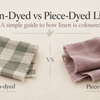
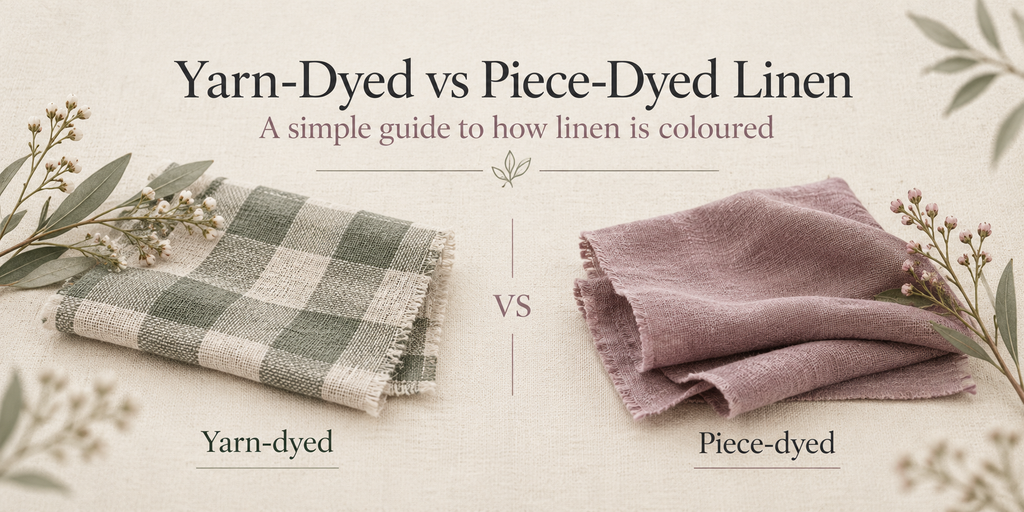
With yarn-dyed linen, the yarn is coloured before the fabric is woven. With piece-dyed linen, the fabric is woven first and then dyed as a finished length of cloth.
Both methods can produce beautiful linen. Neither is automatically better; they are simply suited to different colours, patterns and production methods.
What Is Yarn-Dyed Linen?
In a yarn-dyed fabric, the linen yarn is dyed before weaving.
The mill can then combine yarns of different colours during weaving to create patterns such as:
- stripes
- checks
- ginghams
- plaids
- chambray-style colour effects
This is one of the main reasons yarn dyeing is commonly used for woven patterns.
For example, a navy-and-white linen check may be woven using navy yarn in one direction and white yarn in another. The pattern is therefore created as part of the fabric construction, rather than printed or applied to the surface afterwards.
Yarn-dyed linen can be useful when:
- the design contains more than one woven colour
- stripes or checks are part of the weave
- you want colour interaction between warp and weft yarns
- the woven structure itself is an important part of the appearance
What Is Piece-Dyed Linen?
Piece dyeing happens later in production.
First, the linen yarn is woven into fabric. The completed fabric is then dyed to create the required colour. This is commonly used for solid-coloured fabrics.
For example, a natural-coloured woven linen may later be piece-dyed into olive, navy, pink or another solid shade.
Piece dyeing is widely used because it gives manufacturers flexibility to produce colours after the fabric has already been woven.
Piece-dyed linen is commonly suitable for:
- solid colours
- seasonal colour ranges
- plain apparel linen
- plain home furnishing linen
- collections where the same base fabric is offered in multiple colours

Yarn-Dyed vs Piece-Dyed Linen at a Glance
| Yarn-Dyed Linen | Piece-Dyed Linen | |
|---|---|---|
| When is it dyed? | Before weaving | After weaving |
| What is dyed? | Individual yarns | Finished fabric |
| Common appearance | Checks, stripes, plaids and multi-colour woven designs | Solid colours |
| How is the pattern created? | Different coloured yarns are woven together | Usually not used to create woven multi-colour patterns |
| Production advantage | Allows colour to become part of the woven design | Offers flexibility in producing solid colour ranges |
Does Yarn-Dyed Linen Mean Better Quality?
Not necessarily.
Yarn-dyed and piece-dyed describe a production method, not a quality grade.
A well-made piece-dyed linen can be an excellent fabric, just as a well-made yarn-dyed linen can be.
Quality and suitability also depend on factors such as:
- fibre quality
- yarn
- weave
- fabric density
- GSM
- finishing
- washing treatment
- colourfastness
- intended use
The dyeing method alone should not determine which linen you choose.
Does the Dyeing Method Affect Colourfastness?
It is tempting to assume that yarn-dyed fabric must always retain colour better because the yarn is dyed before weaving.
In practice, colourfastness depends on more than the stage at which the fabric is dyed. Dye chemistry, fibre preparation, dyeing conditions and finishing all affect how a colour performs.
Linen is a cellulose fibre, and dye systems suitable for cellulose fibres can be used to colour it.
For this reason, it is better to follow the care instructions for the individual fabric rather than assuming one dyeing method will always perform better than another.
What About Printed Linen?
Printed linen is different again.
With printing, colour or a design is applied in selected areas of the fabric rather than simply dyeing the entire yarn or piece one colour.
A stripe, for example, could therefore be:
- yarn-dyed, where coloured yarns form the stripe during weaving, or
- printed, where the stripe design is applied to the finished fabric.
Looking closely at both sides of the fabric can sometimes help identify the construction, although the product description is the most reliable guide.
Which Should You Choose?
For most sewing projects, you do not need to choose between yarn-dyed and piece-dyed linen purely because of the dyeing technique.
Instead, start with the fabric you need for your project.
Consider:
- colour or pattern
- GSM
- drape
- weave
- width
- opacity
- finish
- whether the fabric has been prewashed
- suitability for your pattern or home sewing project
If you want a woven check, stripe or gingham, a yarn-dyed linen is often a natural choice.
If you are looking for a plain linen in a particular solid colour, piece-dyed linen is very common.
The Simple Difference
The easiest way to remember it is:
Yarn-dyed: colour the yarn → then weave the fabric.
Piece-dyed: weave the fabric → then colour the fabric.
Neither method is inherently superior. They simply allow mills to create different types of linen fabric.
When shopping online, look beyond the dyeing method and consider the fabric as a whole — including its weight, width, weave, drape and finish.
A note about swatches: de Linum offers swatches for most fabrics, so you can see the colour in your own light and feel the texture, weight and drape before committing to a larger quantity.